

Businesses operating across Pakistan, Saudi Arabia, and the UAE know the frustration better than anyone. You land a client in Europe or the United States, you deliver the work, and then the payment process begins. Your Wise account gets flagged. Your Payoneer withdrawal is delayed or blocked entirely. You wait five days for a SWIFT transfer to clear, and by the time the money arrives, 4 to 5 percent has quietly disappeared in fees and conversion markups.
For businesses and freelancers in this region, this has become so routine that most have simply accepted it as the cost of working globally. It should not be.
The numbers make the scale of this problem hard to ignore. In 2024, remittance inflows to Pakistan surged by 31 percent, reaching $34.6 billion, with Saudi Arabia as the largest source at $7.4 billion and the UAE contributing a further $5.5 billion. Gulf remittance outflows reached $131.5 billion in 2024, with $77 billion from Saudi Arabia and the UAE alone.
For recipient countries, these flows are not merely supplementary income; they are vital economic stabilisers that often outstrip foreign direct investment and official development assistance. Yet despite this volume, the infrastructure serving the people sending and receiving this money remains slow, expensive and inaccessible.
The global average cost of sending $200 stands at 6.4 percent, more than twice the 3 percent target set by the UN Sustainable Development Goals. For freelancers and small business owners who lack the banking relationships of large corporates, the effective cost is often higher still.
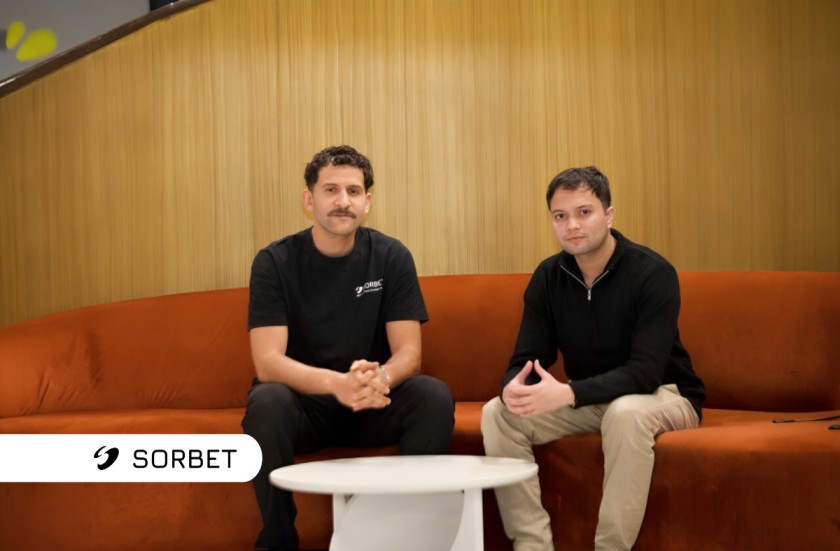
Sorbet was founded in Riyadh to challenge exactly that assumption. “We use stablecoins in the background to move money at internet speed, while delivering fully compliant local payouts in every market we operate in,” said Maher Ayari, co-founder and CEO of Sorbet. “Our users get the speed and cost savings of stablecoin infrastructure wrapped in the same fintech experience they are already used to. Best of both worlds.”
The Riyadh-based fintech has built a global payments platform designed specifically for businesses and freelancers operating across the Gulf, Pakistan and beyond. Sorbet recently announced the launch of local payouts in Saudi Riyal (SAR), Pakistani Rupee (PKR) and UAE Dirham (AED), enabling users to receive international payments in USD, AED, EUR and GBP and send directly to local bank accounts in all three countries, with near-instant settlement and fees as close to the mid-market rate as the market currently offers.
The timing reflects a broader shift in how money moves globally. Stablecoins such as USDC and USDT have processed over $27 trillion in transaction volume over the last three years, surpassing the annual transaction volumes of Visa and Mastercard individually. Yet the speed and cost efficiency that stablecoins make possible has remained largely inaccessible to the businesses that need it most: the agency owner in Lahore invoicing a Dubai client, the Saudi consultant billing a New York firm, the Dubai-based startup paying a remote team in Karachi.
Sorbet uses stablecoins as the settlement layer behind the scenes, while presenting users with a straightforward experience that requires no knowledge of blockchain or crypto. A business receives payment in USD from a US client. Sorbet converts and routes it locally. The recipient receives SAR, PKR, or AED in their bank account, typically within the same business day. No wallets to manage, no crypto exchanges to navigate, no five-day waits.
The underserved nature of this market is not an accident; it is a structural gap. Individuals in the UAE are losing up to 5 percent per cross-border transaction, with businesses facing similar friction despite the UAE’s otherwise welcoming economic environment. Freelancers and small business owners have been the hardest hit, lacking the negotiating power to access better rates and the operational resources to manage fragmented multi-bank setups. Most businesses currently working across multiple currencies operate a patchwork of two or three bank accounts, a Wise account, and a separate crypto wallet when dealing with USDC or USDT payments. The operational overhead of managing that stack consumes time and money that should be invested back into the business.
“We built Sorbet because the infrastructure for global payments already exists — it just was not being used for the people who needed it most,” said Maher Ayari, co-founder and CEO of Sorbet. “Businesses in our region have been paying a premium for years just to receive what they already earned.”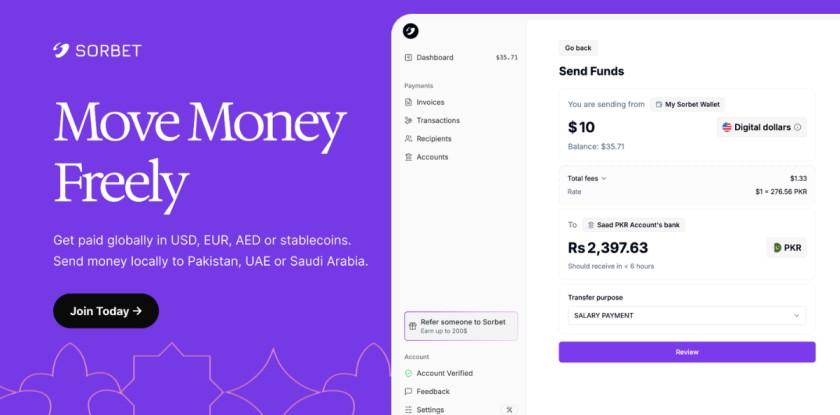
Sorbet consolidates all of it into one account. Receive USD, EUR or GBP from international clients. Pay teams locally in PKR, SAR or AED. Hold stablecoins. Move between them without the conversion losses that traditional banking layers on at every step.
Get paid globally. Send money locally. Move money freely by Sorbet.
If your business deals in USD, USDT, GBP or EUR and needs to pay teams locally in PKR, SAR or AED, Sorbet is built for your operations.
Reach out directly at maher@mysorbet.xyz or open an account at mysorbet.io.

1 comments