

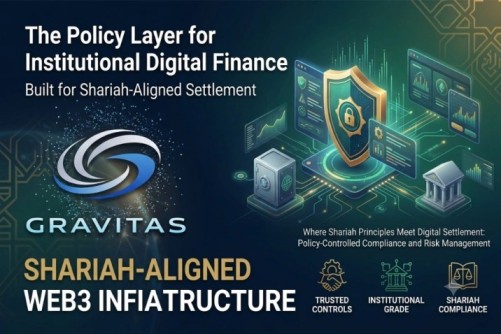
How institutional controls and policy-driven execution could bridge the gap between exploration and responsible deployment
The Challenge: From Exploration to Responsible Deployment
As banks, payment companies, Gravitas Protocol stablecoin issuers, and investment firms explore blockchain-based settlement, the main challenge is moving from early exploration to responsible deployment.
Institutions want the speed and programmability of digital assets, but they also need clear rules around permitted assets, transaction purpose, jurisdictions, counterparties, liquidity routes, reporting and risk controls. For Islamic-finance institutions, those questions also include concerns around riba, gharar, maysir and the treatment of speculative or uncertain transactions.
Gravitas Protocol: The Solution
Gravitas Protocol is being developed to address this institutional control problem. Built on Arbitrum, the project is creating a non-custodial, policy-controlled routing and settlement layer for selected digital-asset, stablecoin, tokenised-asset and cross-border payment use cases.
The core idea is straightforward: approved policies should be connected directly to transaction execution.
The contracts are currently deployed and source-verified on the Arbitrum Sepolia testnet, with public documentation and an integration kit available for independent review. Mainnet deployment is pending completion of an independent security audit.
The Policy Registry & Smart-Contract Architecture
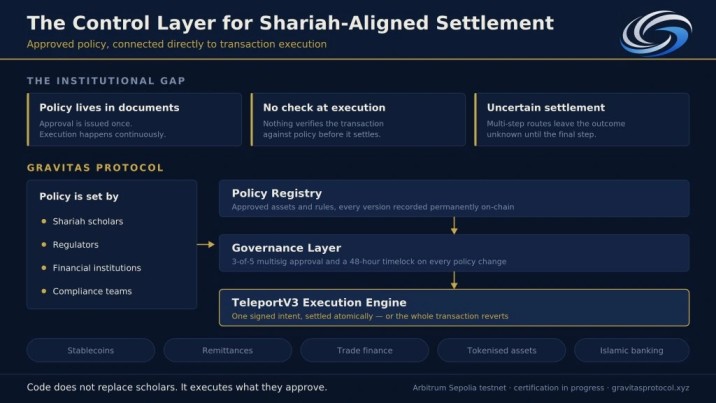
Through its Policy Registry, Gravitas is designed to record approved asset and use-case policies. Its smart-contract architecture can then evaluate whether a proposed transaction meets predefined conditions. Where those conditions are not met, the transaction can be restricted or reverted rather than proceeding through an unauthorised or incomplete route.
Policy changes are governed rather than discretionary: updates require multi-signature approval and pass through a timelock delay before taking effect, and every version of every policy remains permanently recorded on-chain. For an institution or a Shariah board, this produces an audit trail that cannot be quietly amended after the fact.
TeleportV3: Atomic Execution and Exact-Output Logic
The platform’s TeleportV3 architecture is designed around atomic execution, exact-output logic, and liquidity routing.
Atomicity is the central design decision. A migration or settlement that would conventionally require four to six separate transactions is executed as a single operation, bound to parameters the user has signed in advance. It either completes exactly as authorised, or it does not happen at all. There is no partial state in which an institution has exited one position without having entered the next.
The objective is to reduce uncertainty around what an institution is receiving, where liquidity is sourced and whether the transaction completed according to the approved parameters. For Islamic-finance institutions, that uncertainty is not only an operational concern but a Shariah one, since gharar attaches to outcomes that cannot be known in advance.
A Critical Distinction
Gravitas Protocol is not claiming that code can replace scholars, regulators, lawyers or institutional compliance teams. It does not decide whether an activity is Shariah-compliant. Its intended role is to operationalise approved legal, regulatory and Shariah policies consistently through software controls and clearer execution records.
That could become increasingly important as Islamic-finance institutions consider stablecoins, tokenised assets, sukuk, digital settlement and cross-border payment infrastructure. A bank or fund may have a legitimate commercial reason to explore these markets, but still lack the internal controls required to participate at scale. A policy-controlled execution layer could help bridge that gap.
The Road Ahead
Gravitas Protocol is targeting mainnet launch following completion of an independent tier-1 security audit and formal Shariah certification, both of which are funded by the current pre-seed round. Timing is subject to technical, security, regulatory and commercial readiness rather than to a fixed date.
Near-term priorities are to:
- Complete work connected to existing LOIs
- Finish technical and security documentation
- Clarify licensing requirements
- Structure focused pilots and establish a repeatable commercial model
Navigating Institutional Finance Risks
The company also faces the risks typical of institutional financial infrastructure. Banks and regulated firms have long sales cycles. Security, bridge, oracle, permissioning, key-management, liquidity, and regulatory risks all require careful treatment. A letter of intent is not the same as paid production, and the project will need to show how early interest converts into customers, transaction volume and sustainable revenue.
Why the Pre-Seed Focus Matters
Gravitas Protocol’s pre-seed round is aimed less at proving that a concept can be built and more at building the institutional trust required for deployment. Security audits, clear documentation, independent review, licensing preparation and disciplined customer conversion will be as important as the underlying smart contracts.
The Broader Thesis
Digital-asset adoption will increasingly depend on infrastructure that institutions can govern, audit and explain. The winning platforms may not be the ones that simply make transactions faster. They may be the ones that make digital-asset settlement easier for banks, funds, payment companies and Islamic-finance institutions to evaluate and control.
Gravitas Protocol is building toward that opportunity: a policy-controlled settlement and liquidity-routing layer designed to help approved digital-asset flows move from institutional exploration toward responsible, auditable execution.
